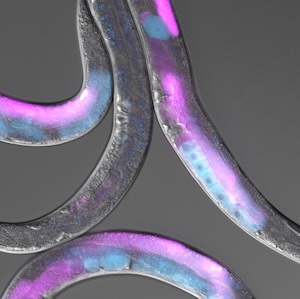
We use the model organism Caenorhabditis elegans to decode the molecular pathways that govern fertility from structure to phenotype.

By defining the molecular parts list and wiring diagram of reproduction in a simple model organism, we are laying the groundwork to better understand the causes of infertility and miscarriage.

We use cutting-edge genome editing technology together with biochemical, biophysical, and sequencing-based methods to define the molecular events required for successful embryo development.

We are a team of dedicated researchers who seek to unlock the mysteries of how living things reproduce.
Haik V. Varderesian, Juliet N. Utaegbulam, Hannah E. Brown, Beverly Ramirez, Melina Velcani, and Sean P. Ryder*
PLOS Genet. (2026) Apr 27;22(4):e1012129. doi: 10.1371/journal.pgen.10121
During fertilization, haploid gametes combine to form a zygote. The male (sperm) and female (oocyte) gametes contribute a similar amount of DNA, but the oocyte contributes nearly all the cytoplasm. Oocytes are loaded with maternal mRNAs thought to be essential for embryonic patterning after fertilization. A conserved suite of RNA-binding proteins (RBPs) regulates the spatiotemporal translation and stability of maternal mRNAs. POS-1 is a CCCH-type tandem zinc finger RBP expressed in fertilized Caenorhabditis elegans zygotes from maternally supplied mRNA. POS-1 accumulates in the posterior of the embryo where it promotes posterior cell fate. Here, we show that the pos-1 3' untranslated region (UTR) is essential for POS-1 patterning and contributes to maximal reproductive fecundity. We engineered a pos-1 mutant where most of the endogenous pos-1 3'UTR was removed using CRISPR genome editing. Our results show that the 3'UTR represses POS-1 expression in the maternal germline but increases POS-1 protein levels in embryos after fertilization. In a wild-type background, POS-1 repression via the 3'UTR has little impact on fertility. In a sensitized background, the deletion mutant has a complex pleiotropic phenotype where most adult homozygous progeny lack either one or both gonad arms. Most phenotypes become more penetrant at elevated temperature. Together, our results support an emerging model where the 3'UTRs of maternal transcripts, rather than being essential, contribute to reproductive robustness during stress.

A conserved triple arginine motif in OMA-1 is required for RNA-binding activity and embryo viability
Asli Ertekin, Sharon T. Noronha, Christable Darko, Francesca Massi, Sean P. Ryder.
RNA, (2025) 31(11):1575-1588
Sexually reproducing organisms make haploid gametes—oocytes and spermatocytes—that combine during fertilization to make an embryo. While both gametes contain similar DNA content, oocytes contain the bulk of the cytoplasm including maternally supplied mRNAs and proteins required prior to zygotic gene activation. RNA-binding proteins are key regulators of these maternal transcripts. In Caenorhabditis elegans, the tandem zinc finger proteins OMA-1 and OMA-2 are required for fertilization. Here, we show that OMA-1 RNA-binding activity requires a short basic region immediately upstream of the canonical tandem zinc finger domain. Mutation of this region in animals produces a phenotype distinct from a genetic null. Oocytes can be fertilized, but fail to form an intact chitin eggshell, frequently fragment in utero, and arrest prior to morphogenesis. Our results identify a critical region outside of the canonical RNA-binding domain required for both RNA-binding activity as well as revealing a new role for OMA-1 during the oocyte-to-embryo transition.
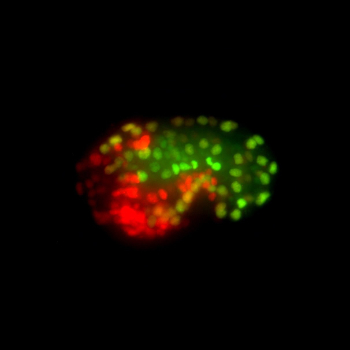 The mex-3 3' untranslated region is essential for reproduction during temperature stress.
Hannah E. Brown, Haik V. Varderesian, Sara A. Keane, Sean P. Ryder
Development (2025) Aug 11:dev.204740. doi: 10.1242/dev.204740Organisms must sense temperature and modify their physiology to survive environmental stress. Elevated temperature reduces fertility in most sexually reproducing organisms. Maternally supplied mRNAs are required for embryogenesis. They encode proteins that govern early embryonic patterning. RNA-binding proteins (RBPs) are major effectors of maternal mRNA regulation. MEX-3 is a conserved RBP essential for anterior patterning of Caenorhabditis elegans embryos. We previously demonstrated that the mex-3 3´ untranslated region (3´UTR) represses MEX-3 abundance in the germline yet is mostly dispensable for fertility. Here, we show that the 3´UTR is essential during thermal stress. Deletion of the 3´UTR causes a highly penetrant temperature sensitive embryonic lethality phenotype distinct from a mex-3 null. Loss of the 3´UTR decreases MEX-3 abundance specifically in maturing oocytes and early embryos during temperature stress. Dysregulation of mex-3 reprograms the thermal stress response by reducing the expression of hundreds of heat shock genes. We propose that a major function of the mex-3 3´UTR is to buffer MEX-3 expression during fluctuating temperature, ensuring the robustness of oocyte maturation and embryogenesis.