Getting to Know Scott Dixon, PhD
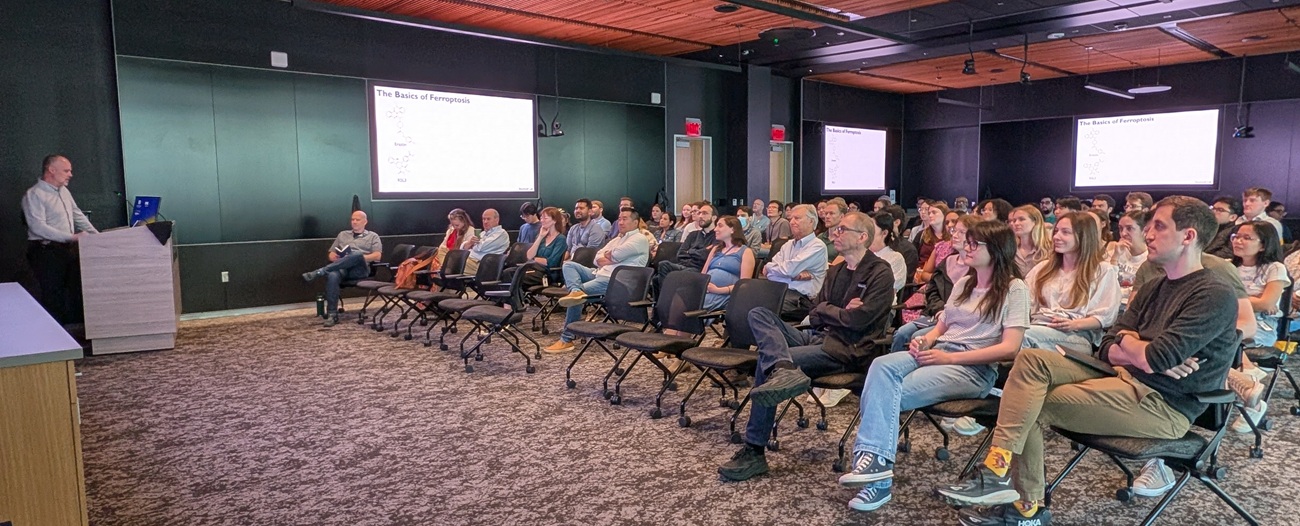
Date Posted: Wednesday, April 01, 2026MetNet was pleased to welcome Scott Dixon, Professor of Biology at Stanford University, to speak at our April 2026 meeting.
Born in Ottawa, Canada, Dr. Dixon earned his PhD at the University of Toronto, where he studied regulatory networks controlling neuromuscular development in C. elegans. He then made his landmark discovery of ferroptosis while at Columbia University in the lab of Brent Stockwell—his Cell paper on the subject has now garnered over 18,000 citations.
Dr. Dixon established his laboratory at Stanford in 2014, where his team continues to build on this foundational work to explore the broader question of how perturbations in intracellular metabolic networks lead to ferroptosis and other forms of regulated cell death.
As per MetNet tradition, we asked Scott some science and non-science questions about himself.
Recent movie or TV series you recommend?
Narcos (the original, and Narcos: Mexico). The premise revolves around small bioactive molecules.
Were there any “Eureka” moments in your career? Or any notable failures that ended up being turning points?
There are many failures. The most interesting failure was early in my postdoc. I went to Brent Stockwell’s lab absolutely convinced that the mitochondria was a driving force behind the induction of what we came to call ferroptosis. After screening every mitochondrial gene using Vamsi Mootha’s new (at the time) shRNA library, it became obvious that actually the mitochondria was not so important, at least in the systems we were studying. That process of acceptance took about two years. But that "failure" set the stage to really think deeply about alternative mechanisms and also to mature as a scientist in terms of accepting that sometimes a great hypothesis is wrong and that what matters is how you adapt.
What unique or funny Dixon Lab traditions have formed through the years?
An extremely rigid tradition is that anytime someone is about to leave the lab (whether an undergrad, a rotation student, a PhD student, etc.) we always have lunch at a local Indian buffet - DarBar. Always DarBar and only DarBar. These are the mornings when I do not eat breakfast. You start eating lunch as soon as you arrive; if someone is late, too bad! I have spent something like 5,000 bucks at DarBar lab lunches over the years. All totally worth it.
What would you say are your best habits—science-related and non-science?
My best habit science-wise, is probably consistency (exciting!). I work every day at least a little bit and don’t get too high or too low when good or bad things happen.
What do you wish you could do if you had more free time?
Learn bicycle maintenance in depth. The rear derailleur…how does it work?
Do you have a hidden talent that most people don’t know about?
Sadly, none. All the non-science talents I had were sports-related, as a youth, and those vanished in a puff of smoke the moment I turned 25.
What profession would you be in if you weren’t a scientist?
Teacher, like the rest of my family.
Looking back on your path so far, any advice for trainees?
Don’t succumb to cynicism about our current science ecosystem. To paraphrase a famous politician: "it’s the worst system for discovering the truth, except for all the others.”